


 Protection
Shading & Netting
Insect Nets
Physical exclusion at 40 and 50 mesh. The only pest control that does not build resistance, leave residue or need reapplying.
Overview
The barrier that does not need spraying
Every chemical control programme is a race against resistance. Insect netting is not. A pest that cannot physically pass the mesh does not develop tolerance to it, does not leave residue on the crop, and does not need reapplying every fourteen days.
The specification that matters is mesh count — the number of openings per linear inch. Higher mesh means smaller apertures and finer exclusion. The trade-off is airflow: a 50 mesh net excludes thrips but restricts ventilation more than a 40 mesh, which means you need to think about vent area and internal temperature at the same time you think about pests.
This is the part that gets missed. Fitting fine mesh to an under-ventilated structure trades an insect problem for a heat problem. Vent area often has to increase when mesh count goes up — sometimes substantially. We would rather tell you that before you install than after your first summer.
Our netting is knitted UV-stabilised HDPE, supplied by the roll and cut to vent or span dimensions. Standard 40 and 50 mesh cover most Indian protected cultivation requirements.
Features
Exclusion without residue
Calibrated mesh count
Consistent aperture across the roll — a net is only as good as its largest hole.
Whitefly & thrips rated
40 mesh for whitefly and aphid; 50 mesh where thrips pressure is the driver.
UV-stabilised
Fine filaments are the first to embrittle. The UV package is not optional at this gauge.
Airflow considered
We specify mesh against your vent area, not in isolation from it.
No residue, no resistance
A physical barrier works the same in year five as in year one.
Cut to vent dimension
Supplied to your opening sizes to reduce seams and fitting labour.
Specifications
Mesh selection
Mesh count drives both exclusion and airflow restriction. The right answer balances your pest pressure against your ventilation capacity.
| Mesh | Approx. Aperture | Excludes | Airflow Impact | Typical Use |
|---|---|---|---|---|
| 40 mesh | ~0.35 mm | Whitefly, aphid, leaf miner | Moderate | General polyhouse, vegetable |
| 50 mesh | ~0.25 mm | Thrips, whitefly, aphid, leaf miner | Higher | Floriculture, high thrips pressure |
Aperture figures are nominal. Effective exclusion depends on correct installation — a well-specified net with an unsealed edge excludes nothing. Increasing mesh count reduces airflow; vent area may need to increase accordingly. We will flag this at quotation stage rather than leave you to discover it in May.
Material & construction
- UV-stabilised HDPE, virgin grade
- Knitted construction — does not unravel
- 40 and 50 mesh standard
- White / natural colour for light transmission
Supply & fitting
- Cut to vent or span dimension
- Edge reinforcement available
- Fixing profiles and clips in the same order
- Batch and mesh grade recorded per dispatch
Applications
Where exclusion netting goes
Any opening through which a pest can walk or fly into a protected crop.
Advantages
Why growers move to netting
Insect netting is a capital cost that displaces a recurring one. The arithmetic usually favours the net well inside two seasons — and that is before you price the residue risk.
- No resistance development. A mesh aperture does not become less effective over time. A chemical does.
- Residue-free crop. Critical for export, organic certification and any buyer running MRL testing.
- Lower spray programme cost. Fewer applications, less labour, less equipment time, less chemical.
- Virus vector control. Excluding whitefly and thrips excludes the viruses they carry — often the real economic damage.
- Beneficial-safe. Netting does not kill your predatory mites or pollinators the way a broad-spectrum spray does.
- Works while you sleep. Passive, continuous protection with no application window and no re-entry interval.
Gallery
Fitted on site
Industries
Sectors we supply
FAQ
Common questions
It comes down to which pest is driving your losses. 40 mesh excludes whitefly, aphid and leaf miner and restricts airflow moderately. 50 mesh additionally excludes thrips, which are smaller, but restricts airflow more. If thrips are your problem — common in gerbera, rose, capsicum and onion — you need 50 mesh and you need to plan the ventilation around it. If whitefly is the driver, 40 mesh gives you exclusion with less heat penalty.
It can, and this is the failure most people walk into. Any mesh restricts airflow, and finer mesh restricts more. If you fit 50 mesh to a structure sized for open vents, internal temperature will rise and you may trade whitefly damage for heat stress. The fix is designing vent area around the mesh — sometimes substantially more vent than you would otherwise need, sometimes forced ventilation. Tell us the structure dimensions with your enquiry and we will flag this before you buy.
Not entirely, and anyone who says otherwise is overselling. Netting excludes what is outside. It does nothing about pests already inside when you close up, or soil-borne problems, or anything that walks in on planting material or a worker. What it does is dramatically reduce reinfestation pressure, which means your remaining programme is smaller, less frequent and more likely to stay effective. Treat it as the foundation of an IPM programme, not a replacement for one.
Correctly, or not at all — an unsealed edge makes the mesh count irrelevant, since pests simply walk around it. Standard practice is aluminium or PVC profile with locking spring around the opening perimeter, giving a continuous seal that can be removed for cleaning. Loose edges, gaps at the ground and unsealed door openings are where most netted houses fail. We supply matched profiles and springs; specify them with the net rather than improvising.
A UV-stabilised knitted net should give several seasons. Fine filaments are more vulnerable to UV embrittlement than coarser shade net, so the stabiliser package matters more here, not less. The other life-limiter is mechanical: dust loading blocks apertures and reduces airflow over time, and aggressive cleaning damages the mesh. Gentle periodic cleaning extends life; pressure washing does not.
Enquiry
Request a
specification.
Send the target pest, the crop and your structure dimensions. You will get a mesh recommendation — and an honest note on ventilation if the mesh you want will restrict it.
Related
Specified alongside
Products that typically ship in the same order.
Protection
 Structures
 Structures
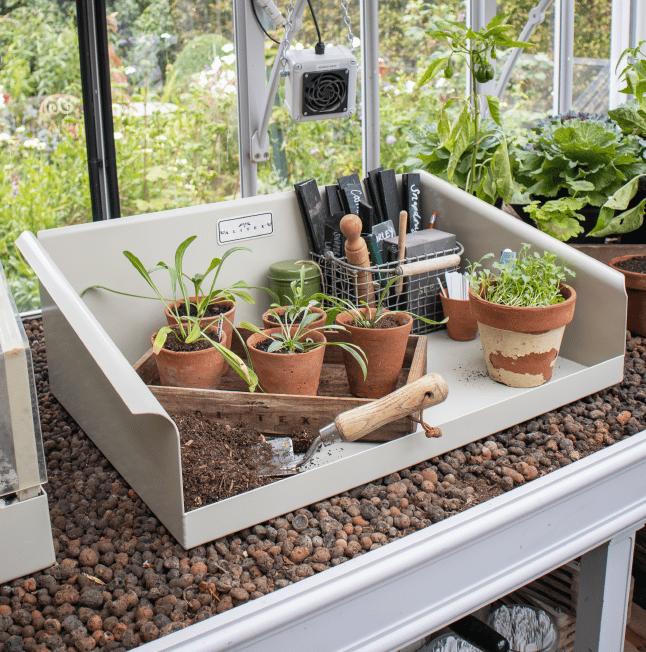
Greenhouse Accessories
Profiles and springs — an unsealed edge makes the mesh count irrelevant.
View product
 Protection