 Growing Media
Cocopeat Blocks
Buffered, low-EC coir pith in 5 kg blocks — the standard fill for plug trays.
View product
Propagation
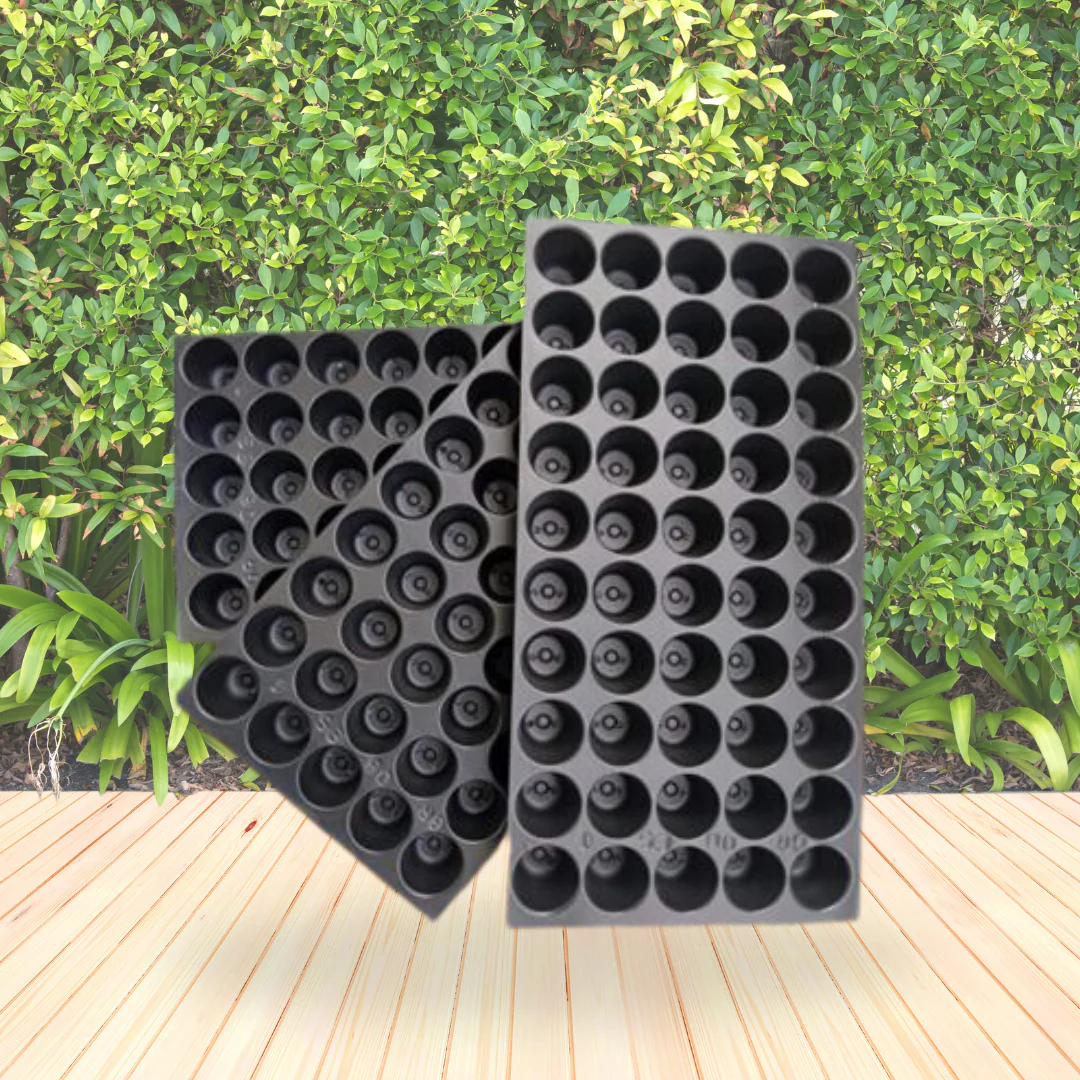
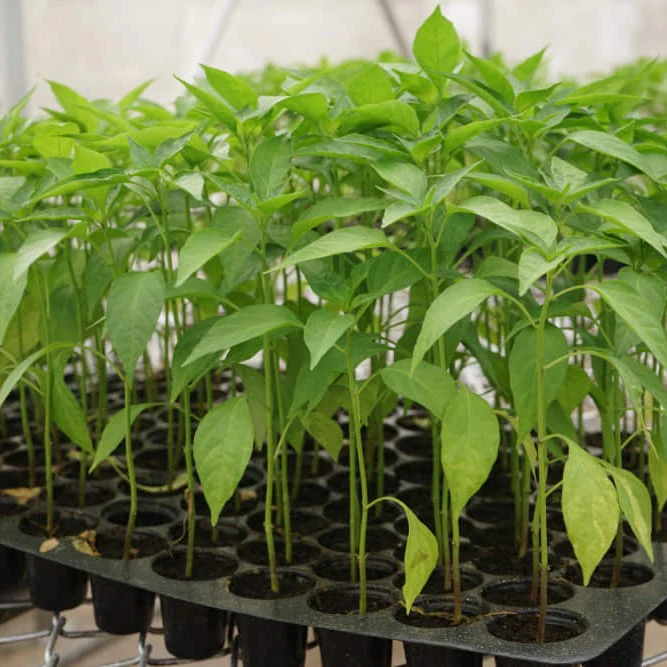
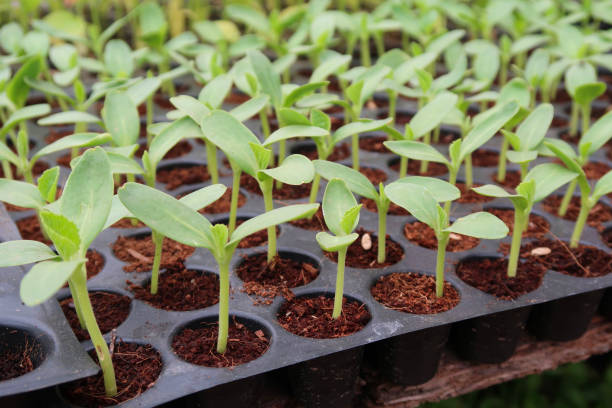
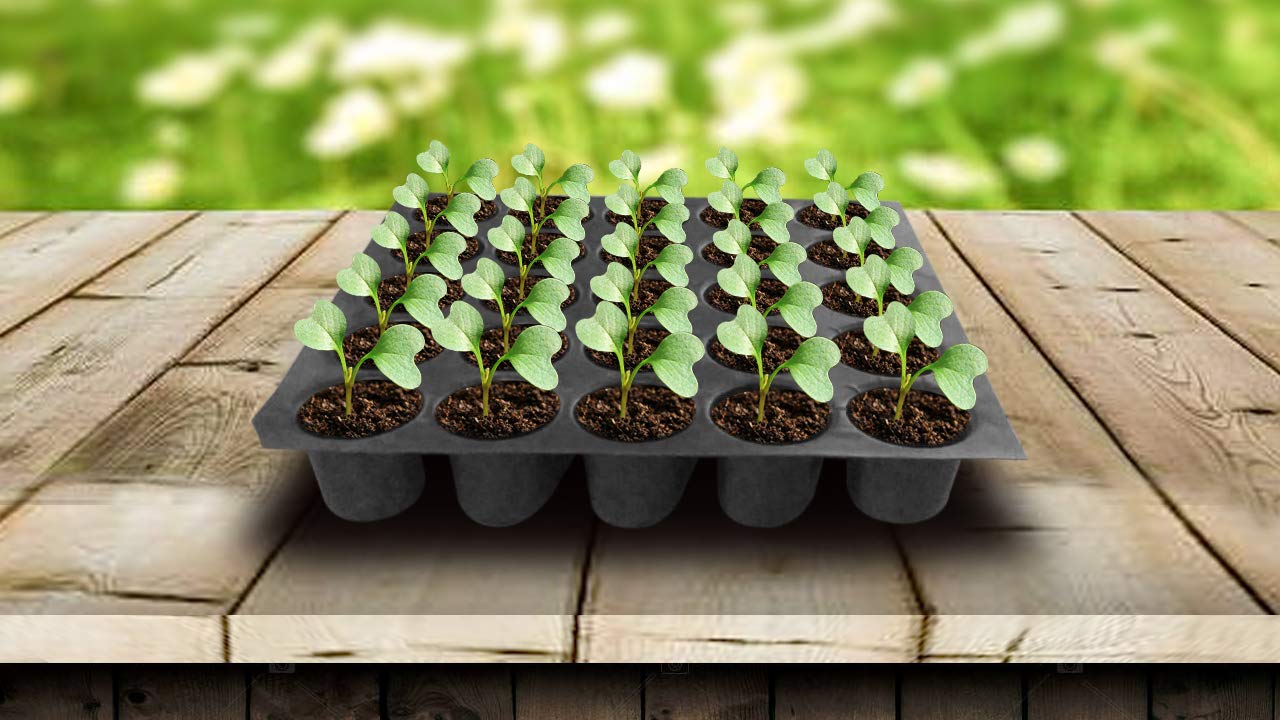
Rigid plug trays in thirteen standard configurations, from 35 to 104 cavities. Engineered for uniform germination, clean extraction and multi-season service.
Overview
A seedling tray looks like a commodity. It isn't. Cavity volume sets root mass, taper sets extraction cleanliness, and drainage geometry sets whether your crop damps off in week two.
GreenLeap plug trays are moulded from rigid high impact polystyrene (HIPS) with a consistent wall section, so a filled tray holds its shape through mechanical filling, watering and handling. Cavities are tapered and bottom-drained: the plug lifts as an intact root ball, and excess water leaves before it stalls the root zone.
We stock thirteen standard configurations across square, round and cup formats. The range covers everything from high-density leafy propagation at 104 cavities down to 8-cup trays for grafted and large-format stock. Where a nursery runs automated seeding, tray footprint and cavity pitch stay consistent batch to batch — the constraint most operators actually care about.
The practical decision is almost always the same trade-off: more cavities means more plugs per square metre but less media per plug. We help you land that against crop, holding period and your bench space — not against what's cheapest per tray.
Features
Dimensional repeatability batch to batch, so vacuum seeders and tray fillers stay calibrated.
Plugs release intact without flexing the tray — the single biggest driver of tray service life.
Each cavity drains rather than perching water, cutting damping-off risk in humid Eastern India conditions.
Resists embrittlement under Indian sun exposure across repeated outdoor cycles.
Compact stack height cuts freight cost per tray and keeps storage footprint down between cycles.
Withstands standard hypochlorite and quaternary sanitation between cycles without surface crazing.
Specifications
Thirteen stock formats. Non-standard cavity counts available against volume commitment — talk to us before assuming a size is unavailable.
| Cavities | Cavity Shape | Tray Size (mm) | Cavity Dia / Width (mm) | Depth (mm) | Typical Use |
|---|---|---|---|---|---|
| 104 | Square | 540 × 280 | 28 | 45 | Leafy greens, tomato, chilli |
| 104 | Round | 540 × 280 | 28 | 45 | High-throughput extraction |
| 102 | Square | 540 × 280 | 29 | 45 | Brinjal, capsicum |
| 98 | Square | 540 × 280 | 30 | 47 | Tomato, chilli, marigold |
| 72 | Square | 540 × 280 | 35 | 50 | Cabbage, cauliflower |
| 70 | Square | 540 × 280 | 36 | 50 | Brassicas, longer hold |
| 67 | Round | 540 × 280 | 36 | 52 | Ornamental propagation |
| 60 | Square | 540 × 280 | 38 | 55 | Cucurbit starts |
| 50 | Square | 540 × 280 | 42 | 58 | Cucumber, melon, papaya |
| 42 | Square | 540 × 280 | 46 | 60 | Large-format vegetable |
| 38 | Square | 540 × 280 | 50 | 62 | Extended holding period |
| 35 | Square | 540 × 280 | 52 | 65 | Grafted stock, large plugs |
| 8 | Cup | 540 × 280 | 90 | 75 | Grafting, specimen plants |
Dimensions are nominal and subject to standard moulding tolerance. Confirm critical dimensions against your seeding line before bulk order.
Applications
Any operation that needs a uniform, transplantable plug on a predictable schedule.
Advantages
The gains from a correctly specified tray are not marginal. They compound across the cycle — germination uniformity feeds transplant uniformity, which feeds harvest uniformity and grading yield.
Gallery
Industries
FAQ
Cavity count is a trade-off between plug volume and trays per square metre. Higher counts — 98, 104 — give more plugs per tray with less media per cell, suiting fast crops like tomato, chilli, brinjal and most leafy vegetables. Lower counts — 35, 38, 50 — give larger root volume for cucurbits, papaya, grafted stock and anything held longer before transplanting. The rule of thumb: if a seedling will sit in the tray beyond roughly four weeks, move to a lower cavity count.
Our HIPS trays are built for multiple cycles, but real service life depends on handling and sanitation rather than the plastic itself. Nurseries that wash, sanitise and store trays flat under cover typically get several seasons. Trays stacked in direct sun between cycles, or flexed hard during extraction, fail earlier regardless of grade. If your extraction crew is bending trays to pop plugs, the cavity taper is wrong for your media — that's worth fixing before buying replacements.
Square cavities hold more media volume in the same footprint and give better root distribution into the corners, which suits most vegetable propagation. Round cavities release the plug more cleanly and are preferred where extraction speed is the bottleneck or where the growing medium is loose. For most commercial vegetable nurseries in India, square is the default; round gets specified when extraction throughput is the constraint.
Yes. Standard tray footprints and consistent cavity pitch allow use with vacuum seeders, tray fillers and de-stackers. If you're running a specific machine, share the make and model with your enquiry and we'll confirm dimensional compatibility before dispatch rather than after.
Buffered, low-EC cocopeat is the standard medium for plug production, often blended with perlite or vermiculite at higher cavity counts where drainage matters more. We supply matched cocopeat blocks and discs, and can specify the blend against your cavity size and crop in the same quote.
Enquiry
Send the crop, the volume and the timeline. You'll get a written recommendation with cavity count, media blend and the reasoning behind both.
Related
Products that typically ship in the same order.
Growing Media
Buffered, low-EC coir pith in 5 kg blocks — the standard fill for plug trays.
 Propagation
Block and single-cell trainers for forestry, plantation and long-hold stock.
 Protection
25%–90% shade factor. Nursery benches almost always need one specified with the trays.
 Growing Media
Pre-formed discs sized to cavity — for operations that skip bulk filling.